opa-java-wasm Has a New Home: Fast, In-Process OPA for the JVM

The Java SDK for running Wasm-compiled OPA policies now lives in the Open Policy Agent GitHub organization. It has new Maven coordinates, and opa-java-wasm 2.1.0 is available on Maven Central. This post covers what changed, how to upgrade, and why you might want to evaluate Rego directly inside your JVM.
What Changed
The project started at Styra, and it has now moved under the OPA umbrella together with a few other community projects. It also switched to a new Wasm runtime along the way. Here is the full picture:
| Before | Now | |
|---|---|---|
| Repository | github.com/StyraInc/opa-java-wasm | github.com/open-policy-agent/opa-java-wasm |
| Maven coordinates | com.styra.opa:opa-java-wasm | org.openpolicyagent:opa-java-wasm |
| Java package | com.styra.opa.wasm | org.openpolicyagent.wasm |
| Wasm runtime | Chicory | Endive |
1.1.0 is the last release under com.styra.opa. From 2.0.0 onwards, releases are published only as:
<dependency>
    <groupId>org.openpolicyagent</groupId>
    <artifactId>opa-java-wasm</artifactId>
    <version>2.1.0</version>
</dependency>
Upgrading is mechanical. Change the dependency, then replace com.styra.opa.wasm with
org.openpolicyagent.wasm in your imports. Apart from the rename, the API is the same.
Many thanks to Styra for incubating the project, and to the OPA maintainers for giving it a home.
What It Is, and Why You'd Use It
OPA can compile Rego policies to WebAssembly with opa build -t wasm. opa-java-wasm loads the
resulting policy.wasm and evaluates it inside your Java process.
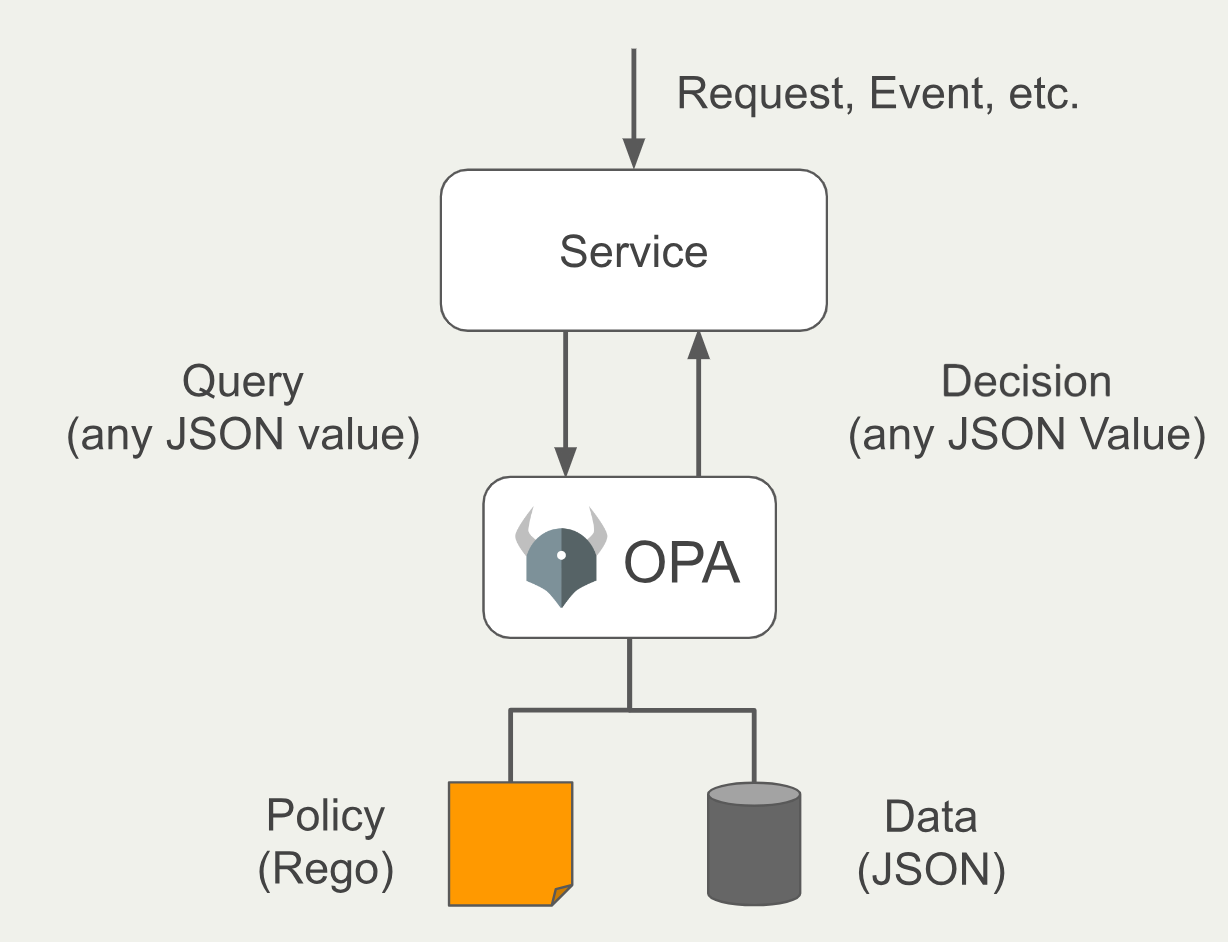
Typically, services invoke OPA over the network, like this:
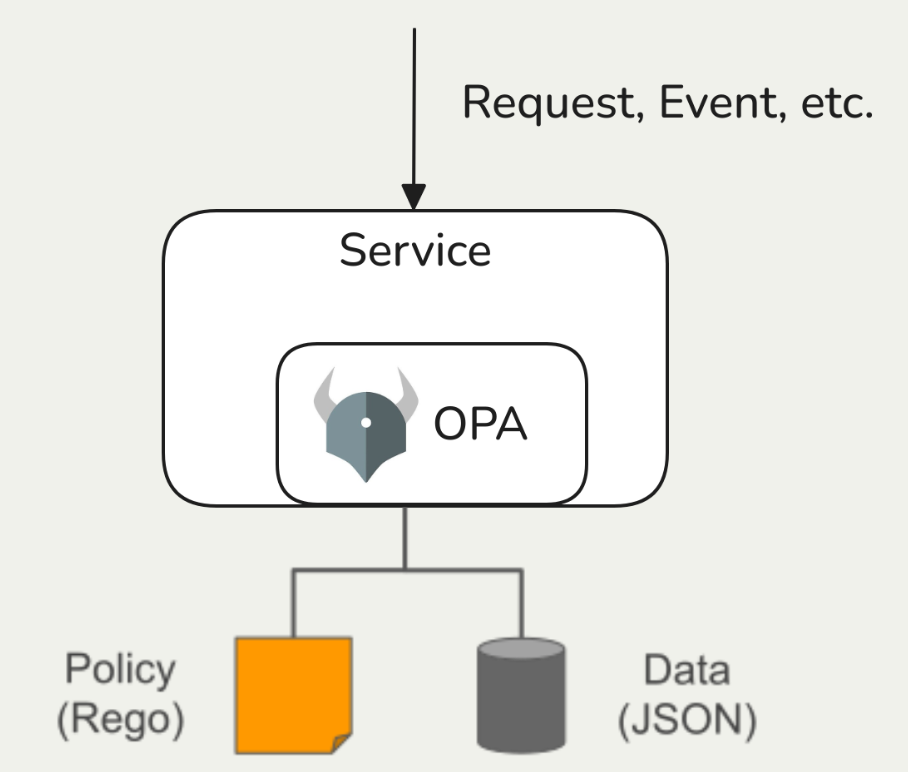
With opa-java-wasm, the compiled policy is loaded into the application directly:
A few properties make this attractive on the JVM:
- Pure Java. The runtime is Endive, a WebAssembly runtime written in Java and hosted by the Bytecode Alliance. There is no JNI and there are no native libraries to ship per platform. If a JVM 11+ runs there, your policies run there too.
- Sandboxed. The policy executes inside the Wasm sandbox. It can only reach the host through the small set of imports defined by OPA's Wasm ABI.
- No extra moving parts. Deploying the service is enough: there is no sidecar to deploy, monitor or scale alongside it.
This is not a replacement for running OPA as a server. The server, and clients like opa-java, remain the right choice when you want the full set of built-in functions, bundle management or decision logs out of the box. The embedded SDK is aimed at hot paths, where a policy decision sits on every request or event and the policy is self-contained. Also check out the Java OPA SDK.
Most built-ins are compiled straight into the Wasm module by OPA. The few that need help from the host are provided by the SDK and you can register your own implementations as custom built-ins.
Why It's Fast
- No network stack. Calling an OPA server costs serialization, HTTP framing and a trip through the kernel's network stack on every decision, even when the server is a sidecar on localhost. Here, a decision is a method call, and the input JSON goes straight into the policy's memory.
- Compiled to plain JVM bytecode. OPA compiles Rego to Wasm, and Endive compiles that Wasm to plain JVM bytecode when the policy is loaded, so no interpreter is involved at evaluation time. The HotSpot JIT sees your policy as ordinary Java code, and profiles, inlines and optimizes it like the rest of your application.
- Compile once, instantiate many (new in 2.1.0).
OpaPolicyFactorycompiles the module once and creates isolated instances cheaply (#218). - Virtual-thread friendly.
OpaPolicyPoolis lock-free internally, so borrowing a policy from a virtual thread doesn't pin its carrier thread.
This pays off most on hot paths: decisions taken on every request, message or tool call, with small inputs. Very large inputs still have to be serialized into the policy's memory on each call.
A One-Minute Demo
Authorization is the usual example, but any decision fits. Here, we validate the tool calls an AI agent wants to make, before running them.
You need the opa CLI and
JBang. Start with a small policy, agent.rego:
package agent

default allow := false

allow if {
    input.tool == "read_file"
    startswith(input.args.path, "/workspace/")
    not contains(input.args.path, "..")
}

allow if {
    input.tool == "run_command"
    input.args.command in {"ls", "git status", "mvn test"}
}
Compile it to Wasm, then extract the module from the bundle:
opa build -t wasm -e agent/allow agent.rego
tar -xzf bundle.tar.gz /policy.wasm
Save the following as Demo.java:
//DEPS org.openpolicyagent:opa-java-wasm:2.1.0

import java.nio.file.Path;
import org.openpolicyagent.wasm.OpaPolicy;

class Demo {
    public static void main(String... args) {
        var policy = OpaPolicy.builder().withPolicy(Path.of("policy.wasm")).build();

        System.out.println(policy.evaluate("{\"tool\": \"read_file\", \"args\": {\"path\": \"/workspace/README.md\"}}"));
        System.out.println(policy.evaluate("{\"tool\": \"read_file\", \"args\": {\"path\": \"/workspace/../etc/passwd\"}}"));
        System.out.println(policy.evaluate("{\"tool\": \"run_command\", \"args\": {\"command\": \"rm -rf /\"}}"));
    }
}
Run it:
$ jbang Demo.java
[{"result":true}]
[{"result":false}]
[{"result":false}]
The read inside the workspace is allowed, while the path traversal and rm -rf / are rejected.
That's all there is to it: no server and no network, with Rego evaluated inside the JVM.
For a concurrent service, combine the factory with the pool. Compilation happens once, and each pooled instance gets its own isolated memory:
var factory = OpaPolicyFactory.builder()
        .withPolicy(Files.readAllBytes(Path.of("policy.wasm")))
        .build(); // parse and compile once

var pool = OpaPolicyPool.create(factory::newPolicy, 4);

try (var loan = pool.borrow()) {
    String result = loan.policy().evaluate("{\"tool\": \"run_command\", \"args\": {\"command\": \"ls\"}}");
}
Get Involved
- Code, docs and issues: github.com/open-policy-agent/opa-java-wasm
- Questions about OPA and Rego: the OPA Slack
- Questions about the Wasm runtime: the Endive Zulip channel
If you're running OPA policies on the JVM, give 2.1.0 a try, and let us know how it goes.